

This May Sound Crazy…
Aphorism and Idioms
Being an English professor and all that jazz, I want to talk about two specific things in this post today.
I want to talk about what is an aphorism, in particular, one that I think about constantly.
I want to talk about idioms and one of them that I recently found quite humorous.
So, we are going to start off serious here and then move distinctly into the more humorous as we go along.
Let’s go!
Aphorisms
What is an aphorism?
First off, they are not proverbs. Proverbs tend to me much older and tend to be traditional sayings with connections that go way back.
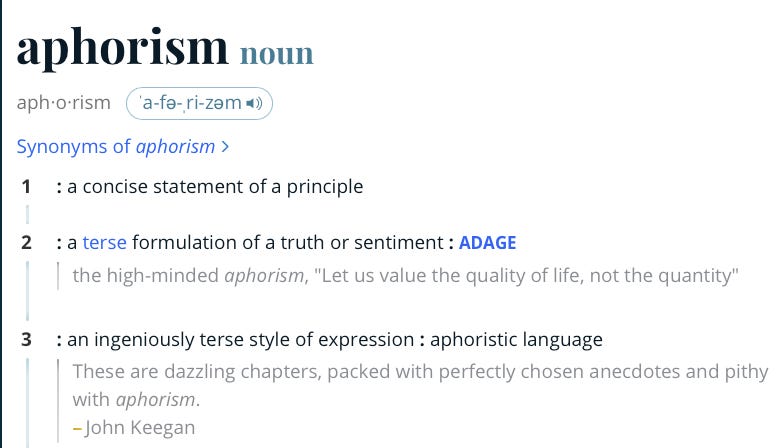
So, aphorisms are concise, terse, and principled statement of some kind of truth.
There are lots of examples of them in the world, here are just a few:
“The secret of getting ahead is getting started.” — Mark Twain
“If it ain’t broke, don’t fix it.”
“The road to hell is paved with good intentions.”
“Don’t cry over spilled milk.”
So, you very likely have heard these, very likely spouted by some adult in your life or someone older, and assumingly wiser.
In our world today, with all the appearing breakdowns in the system, gridlock, and polarization, there is ONE particular aphorism that find myself thinking about a lot (as noted earlier):
“Perfect is the enemy of the good”
Or as I often hear it phrased:
“Don’t let the perfect be the enemy of the good”
If you look it up it usually “means insistence on perfection often prevents implementation of good improvements. The phrase suggests that achieving absolute perfection may be impossible, and that the pursuit of perfection should not prevent someone from recognizing or completing work that is imperfect yet still valuable.”
This is a push back against our sometimes binary, good vs. evil, right vs. wrong impulses that, though valid, are often rarer in life than we imagine.
Most of life is grey, an area where things take on different shades. If we spend all our time fixated on the perfection of one way of doing something or thinking about something against something else, we can lose the plot.
We can actually get bogged down and get NOTHING done.
Honestly, perfection is a curse.
However, let me point out some things where people are letting the pursuit of perfection, or the desire in situations to not compromise and have it all their way or no way at all, prevents anything from happening.
Snapshot Examples
These are not definitive, but simply my takes. Make of them what you want. Comment on them too.
Healthcare
Let’s start with the assumption at hand: The left wants universal healthcare; the right does not.
Why? There are reasons.
Arguments from the left typically argue that healthcare is a human right. Talk of things like Medicare for all are floated and push back on the private Insurance companies that make money hand over fist for medical treatment that is NOT easily accessible or affordable to the majority of Americans. This is a very American problem too, and what we spend in other areas dwarfs what we could be doing to subsidize healthcare access for people without bankrupting them.
The problem is that the left postures itself in purity tests that tend to undermine its outcomes and fracture its coalition. There is this drive for the utopian answer that puts blinders on any idea of compromise or gradual process. We are not going disband insurance companies overnight, but the notion of getting something over nothing is often missed in a quest for the whole pie of desired outcomes. Too much faith in a state subsidized option.
The arguments from the right typically center around personal responsibility and the idea that individuals should do their utmost and NOT rely on state intervention. This means putting faith in a private market.
Problematically, this lives on the assumption that everyone has equal outcomes and equal access. This is not true but it also tends to demagogue notions of government assistance as “communist” or “socialist” as scare tactics designed to shut ideas down.
It feeds into slippery slope fallacies that halt debate and compromise.
Both sides are guilty; both sides see their view as right and the other as wrong. A binary that is false.
“Perfect is the enemy of the good.”
Education
I am going to keep this one short, I have a lot of ideas here and I recently spoke about them on my podcast Not Funny Guys Present Thinking About Thinking. I say a bit more there.
The problem of education, specifically public education, has a lot to do with a fundamental breakdown in our culture and approach. People get tied up in parental rights vs education. This is a false dichotomy.
The quest for perfection here misses the mark by trying to assert that parents are locked out and NOT having input in their child’s education and framing teachers and administrators as “adversarial” to them.
What really needs to happen and we need an honest discussion about this nationwide, is to get back to harder quest of having parents, teachers, and administrators working together. Tripods can be precarious, but it takes a community. It takes building a culture that values education.
“Perfect is the enemy of the good.”
There is NO ONE MAGIC BULLET! Stop looking for it, that is the perfection trap here. Hard work is needed. But nothing is going to get done if we keep turning it into some binary, us vs. them dynamic. That only benefits those who don’t care about education really at all.
Politics
I’m actually going to pass on this one right now. But you can see it in how partisanship makes bipartisan, compromise nearly impossible. Why? You tell me. Everyone has an idea and I would love to hear them.
“Perfect is the enemy of the good.”
Let’s go to the fun stuff now.
Idioms
What is an idiom?
Typically, this is an expression or phrase that is not literal in meaning…but wait, nevermind, let’s look at the formal definition:
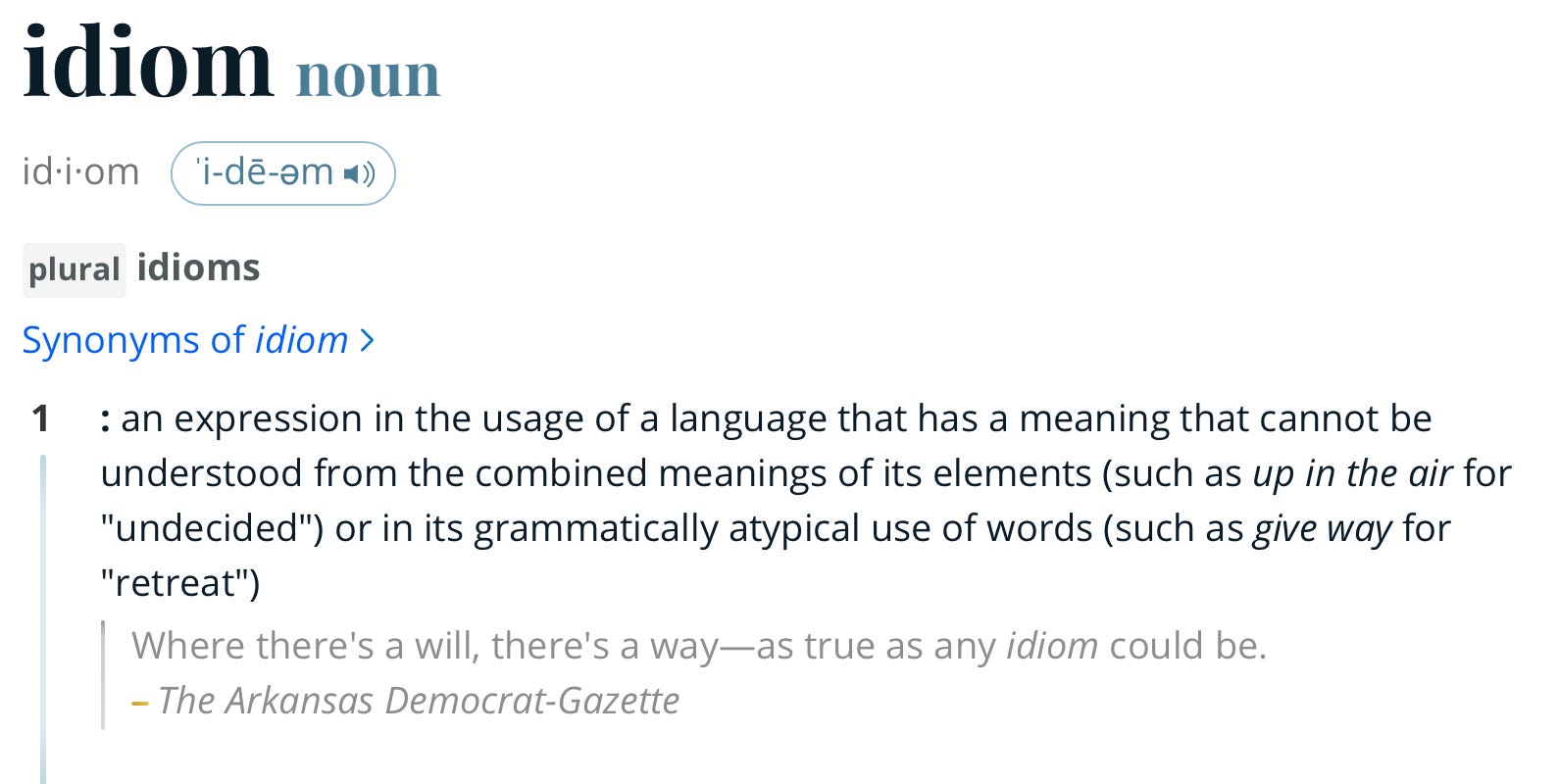
It is typically a phrase of expression that is not literal. Rather, it is something that has figurative meaning. This means that the combination of works has a meaning that is different from the definition of the words themselves individually.
Another thing is that idioms often have a specific cultural context to them as well. They can reflect traditions or common place experiences. You can also not change the words in the idiom without potentially losing its meaning all together.
Common example of idioms:
“Break a leg”: Means “good luck,” usually said to performers before going on stage.
“Spill the beans“: Means to reveal a secret.
“Under the weather”: Means feeling sick or ill.
“Pull someone’s leg“: Means to play a joke on someone, usually by making them believe something untrue.
“It’s raining cats and dogs“: Means it is raining heavily.
Grammatical, Not Grammatical
The other day I was listening to a podcast where someone attempted to use the idiom, “Cross your t’s and dot your i’s” and almost messed it up. This made me chuckle.
For starters, a lot of times it is easy to accidently mess up an idiom. Probably has to do with the fact that this particular idiom has nothing to actually do with grammar.
“Cross your t’s and dot your i’s” is not about punctuation and grammar, but really means that one aims “to be meticulous, precise, and thorough, ensuring every minor detail is completed correctly.”
Since idioms rely on word combination and not literal meaning, I thought it would be funny to get it wrong.
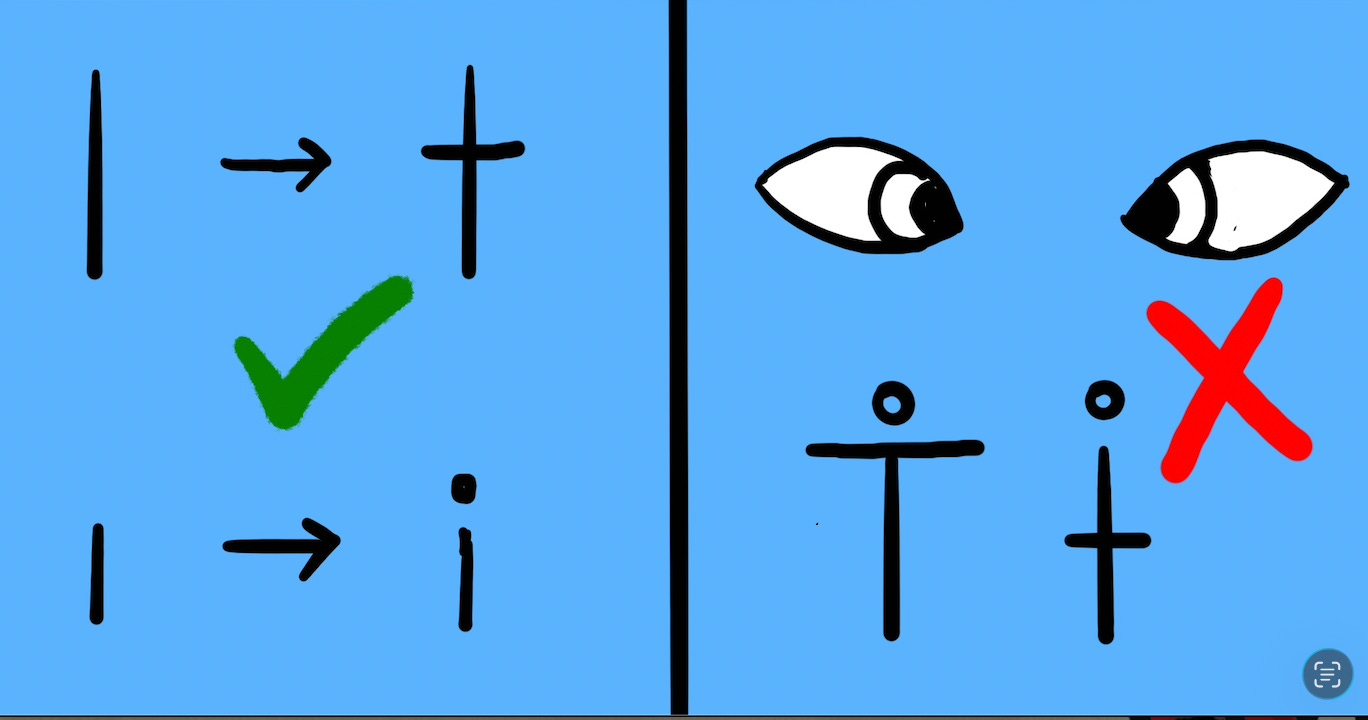
Enjoy!
Till next time!